

Security
What is end-to-end encryption? Why it matters for office data
End-to-end encryption means data is encrypted on your device and can only be opened by authorized people. How it works, how it differs from ordinary encryption, and why it matters for offices.
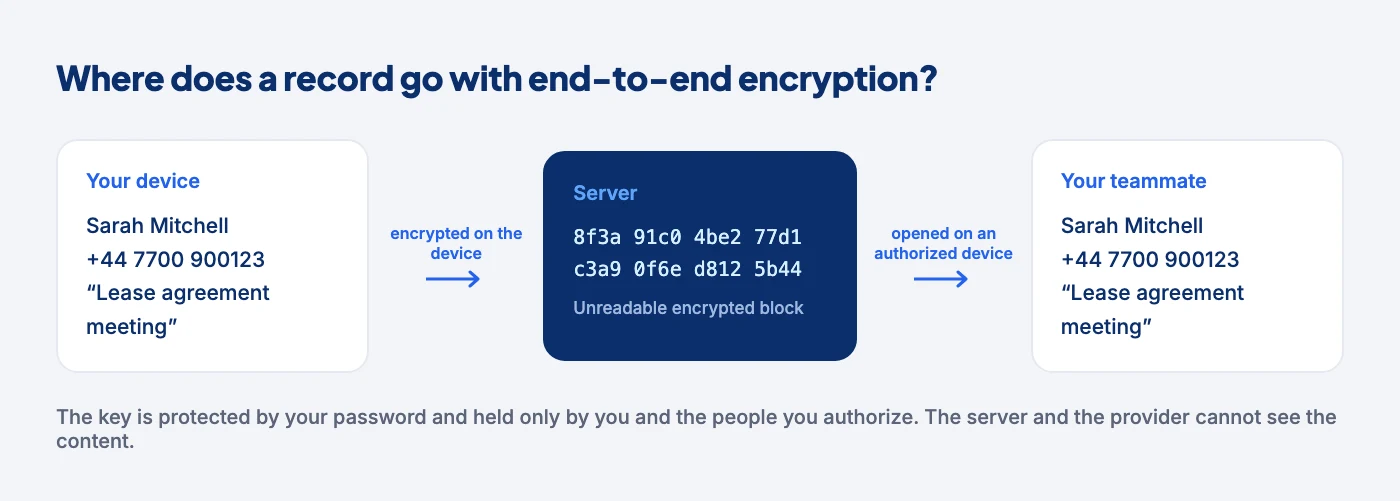
Short answer: End-to-end encryption (E2EE) means data is encrypted on the device where it is sent or saved, and can only be decrypted on the devices of people who hold the key. The server in between, the internet provider and the company running the service carry and store the data but cannot read it. The key never reaches the server in readable form.
How is it different from ordinary encryption?
Almost every website today encrypts the connection (the padlock in the address bar). That stops data from being read in transit. But once the data reaches the server it is decrypted and stored in a form the service provider can read. Most cloud software also encrypts its disks, but the key is still held by the provider.
With end-to-end encryption:
- Data is encrypted on your device,
- Only the encrypted form is sent to the server and stored there,
- The key stays with you and the people you authorize,
- Neither the service provider, nor an attacker who gets into the server, nor anyone who obtains the backups can read the content.
How does it work? (The simple version)
- When you create an account, a key is derived from your password on your device.
- When you add a contact, a note or a document, the content is encrypted with this key on your device.
- The server stores the encrypted block without knowing what is inside.
- When you sign in on another device, the key is derived from your password again and the content is decrypted there.
- When you give a teammate access, the workspace key is passed to them in encrypted form.
What happens if you forget your password?
This is the price of end-to-end encryption: because the provider doesn't know your key, it cannot open your data for you if you forget your password. That is why trustworthy systems give you a recovery key. In Asistansa this is the Recovery Kit you receive at sign-up; keep it somewhere safe.
Why does it matter for offices?
Executive offices, legal practices and consultancies hold very sensitive information:
- Private phone numbers and addresses of senior people,
- Meeting subjects and notes,
- ID and passport details,
- Contracts and confidential correspondence.
If this information comes out in a data breach, the consequences are personal, corporate and legal. End-to-end encryption keeps the content unreadable even if a breach happens. It is also a strong technical measure under data protection rules such as the GDPR.
Questions to ask when choosing an end-to-end encrypted tool
- Is content encrypted on the device or on the server?
- Can the service provider access the key?
- Are fields such as contact names encrypted too, or only documents?
- How does recovery work if the password is forgotten?
- Is encryption done with a trusted, audited library?
- How is access granted to a teammate, and how is it revoked?
End-to-end encryption in Asistansa
In Asistansa, contacts, organizations, requests, tasks, appointments, documents, lists and tags are encrypted on your device. Not even a contact's name appears as plain text in the database or the backups. Encryption uses the widely used and audited libsodium library, and the web and mobile apps use the same method. Phone notifications contain no content either. Nobody, including Asistansa staff, can read your records.
Frequently asked questions
What does end-to-end encryption mean?
Data is encrypted on the device where it is sent or saved, and can only be decrypted on the devices of people who hold the key. The server and service provider in between store the data but cannot read it.
What is the difference between end-to-end encryption and SSL?
SSL (HTTPS) only protects data in transit; once it reaches the server it is decrypted. With end-to-end encryption, data stays encrypted on the server as well, and the service provider doesn't hold the key.
If I forget my password in an end-to-end encrypted app, is my data lost?
Not if you have your recovery key. Because the provider doesn't know your key, the recovery key is the only way to open your data when you forget your password. In Asistansa this is the Recovery Kit you receive at sign-up.
Can Asistansa see my data?
No. Your records are encrypted on your device and only their encrypted form is stored on the server. The key that decrypts them is protected by your password and is not held by Asistansa.